
Hi, it’s Mehdi Yacoubi, co-founder at Mirage Metrics, OrderFlow and Mirage Exploration.
This is The Long Game, a newsletter about technology, operations, AI, building a company, health, wellness and the decisions that compound over years. More than 5,000 people read it.
If you want it in your inbox, you can subscribe here:
In this episode, we explore:
Fatigue
Your unfaire advantage
Vertical vs. General AI
Sales learnings
Let’s dive in!
Health
Why fatigue is the optimal state of man.
If you’re a long-time reader you know what I think of “recovery” and “overtraining”. In short, you are probably very far from overtraining.
Over the last 4 weeks I could not train like I usually do, so I was way less “fatigued” than usual. I felt way worse.
This piece explains what is happening:
Look around. The modern man is fucking broken.
Hunched over keyboards like Quasimodo, drowning in Slack notifications, paralyzed by analysis.
Scared to approach the girl who makes his heart race.
Terrified his business will fail before he even starts.
Living in constant anxiety because his energy is spent in his own mind.
No force, no action, no making moves in the real world.
We’ve been chained to desks for 8 hours a day for the past 150 years, but the problem has reached critical mass in the last 40.
Since computers invaded every office in the 1980s, we’ve created a generation of men who’ve never known what it feels like to be properly worn down.
This is the problem: Your mind is holding you hostage, and exerting yourself physically is the key to unleash those shackles.
The solution is to keep yourself in a state of physical fatigue.
You’re hardwired for physical labor, not cubicle imprisonment.
When you systematically exhaust your body, something magical happens:
Your mind stops overthinking and starts executing.
No more analysis paralysis about your business idea
No more fear of rejection
No more doom-scrolling and mental masturbation
No more caring about politics, gossip, or Kim Kardashian’s latest surgery
You enter a state of pure action. Flow state on demand.
And I am going to give you the exact actions you can take to finally get the fuck out of your own head.
Of course, you can overdo it, and it will backfire, but roughly speaking I think for most us, more will be better :)
Pair with: Exercise as medicine for depressive symptoms?
Wellness
Use your undair advantage
For some reason, this post really hit a nerve and I kept thinking about it. It’s so obvious, but I think that many people are trying to make things harder than they should be for some weird reasons.
So here it is, maybe it will help you as well:
abuse your unfair advantage everywhere
everyone has it
> if you live in your mom's basement w no responsibilities, work 18 hr days
> if your know a guy who knows a guy, use that guy
> if your parents paid for ur college, invest your time in up-skilling urselflife isnt an even playing field
all the "winners" are not playing fair
to catch up you have to identify your unfair advantage
and abuse it
Think hard about any things you have that could help you achieve whatever you’re trying to achieve, and relentlessly use those resources.
No matter what it is, relationships, family, natural abilities, looks, money… Anything. Use the set of cards you were delt with.
Better Thinking
You will be OK
Should you be scared or optimistic related to the fast progress of AI?
Here’s a pessimistic outlook believing we’re headed toward an apocalypse:
A journalist asked me this year why I do what I do if I see unemployment on the horizon. I answered something about how it would be a shame to waste the opportunity on anything less important. Maybe I should have said that extraordinary times call for extraordinary effort.
If there are a few years left, I want to spend them fully, and this is what carries me through most days. I spend hours with my friends, I treat myself often, I work until I can’t string together a sentence. I try to bring others joy, I try to bring myself joy. I feel incredibly lonely still, and the days are often filled with wasted time and self-destructive rotting. I forgive myself, because there is no time to do otherwise.
There were many months where I would look at a leaf, or a building, or a light, and cry because I did not want the world with these things to end, and it seems like it may end. I don’t cry as much anymore, although I do still mourn.
This strikes me as really misguided, and typical of people in the AI bubble in San Francisco. Once you leave this bubble, you start to think that change—as fast as it may be—will actually take way more time than you think.
This is a good response to the doom perspective:
What I mean by "you will be OK" is:
1. A prediction: I believe the most likely outcome is that AI will lead to a vast improvement in the quality of lives for the vast majority of people, similar in scale to the improvement in our lives compared to pre industrial times. Moreover, I believe that, assuming they take care of their physical and mental health, and do not panic, many, probably most, young LessWrong people are well positioned to do very well, and both take advantage of AI as well as help shape it. But this is only one outcome of many.
2. A working hypothesis: I propose that even though there are multiple possible outcomes, including ones where you, I, and everyone, will very much not be OK, people should live their day to day under the hypothesis they will be OK. Not just because I think that is the most likely outcome, but also because, as I said, it is best not to dwell on the parts of the probability space that are outside your control. This was true for most people during the cold war regarding the possibility of a total nuclear war, and is true now.
I do not mean that you should be complacent! And as I said, this does not mean you should let governments, and companies, including my own, off the hook! There is a similar dynamic in climate change, where people get the sense that if they are not "maximally doomerish" about climate change and claim that it will destroy the world then they are being complacent and doing nothing. This is wrong, and seeing climate change as fatal is not just bad for one's mental health, and can have negative impact on your life decisions, but also can lead to wrong tradeoffs.
Pair with: An End to Doomerism
Pessimism sounds smart. Optimism sounds dumb. It’s no wonder, then, that pessimistic messages hit the headlines, and optimistic ones hardly get a middle-page snippet. It’s why doomsday thinkers get respect and accolades.
AI Updates
Vertical vs. General
Back on the general AI vs vertical solutions. A topic important to me because of our work at Mirage.
In the wake of Claude Cowork, this post is interesting:
Amjad is onto something most AI labs haven’t fully internalized yet.
I’ve spent the last year watching verticalized agent startups raise hundreds of millions only to get steamrolled by generic coding agents.
The pattern keeps repeating.
Legal AI agent? Claude Code can read statutes and draft contracts. Medical documentation? Coding agent with the right prompts handles it. Financial modeling? Same story.
The verticalized approach assumes domain expertise is the moat. But Sutton’s bitter lesson says the opposite. General methods that scale with compute always win.
What makes coding agents different is they have somthing no verticalized agent has. A universal interface to the world.
Code can call any API. Code can parse any document. Code can automate any workflow.
Every vertical agent is basically a worse version of a coding agent with guardrails.
The VC math here is BRUTAL.
Enterprise AI startups raised something like $8B in 2024 building bespoke solutions for healthcare claims processing, insurance underwriting, legal discovery.
Meanwhile Cursor hit $1B ARR in 36 months just letting developers write code faster.
And here’s where Amjad’s insight gets really interesting.
He’s right that program synthesis maps exactly to the bitter lesson. Search and learning. Those are Sutton’s two scalable methods.
What is a coding agent doing?
Searching the solution space of all possible programs. Learning from feedback loops. Executing and iterating.
Every handcrafted vertical agent is the equivalent of 1990s chess programs encoding grandmaster knowledge. They work until they don’t.
AlphaZero didn’t need chess theory. Claude Code doesn’t need to be trained on legal precedent.
Microsoft is catching up to this realization late. They built an empire of verticalized Copilots for Sales, Service, Finance.
Replit figured it out early. Give developers a general coding environment and let them build whatever they need.
The winners in AI infrastructure will be the ones who understood program synthesis was the endgame all along.
And here’s the other side:
The counter dynamic to the AI model doing everything is that, at least in enterprise, bridging the AI models’ capabilities to the customer’s environment still requires a tremendous amount of long tail work.
The gap between an AI agent working for 90% or 95% of the solution and 100% is usually about 10X more work than most realize.
Getting access to the enterprise data, connecting to the enterprise workflows, delivering the change management that employees need to adopt the technology, handling the regulatory and compliance requirements of that industry, and so on all require some degree of highly dedicated focus in a domain.
There’s a strong analogy to vertical SaaS here actually. One would have thought that horizontal technologies could solve all problems in SaaS. But in fact there are endless very large companies that just hyper focus on a single domain, because that level of specialization is valued by the enterprise.
We will likely see the same play out with AI Agents in the enterprise as well. And in fact these domains will be far larger than traditional software categories because the TAM isn’t software, it’s work to be done.
Startup Stuff
Sales Learnings
I read a post on X a few days ago, and it intrigued me:
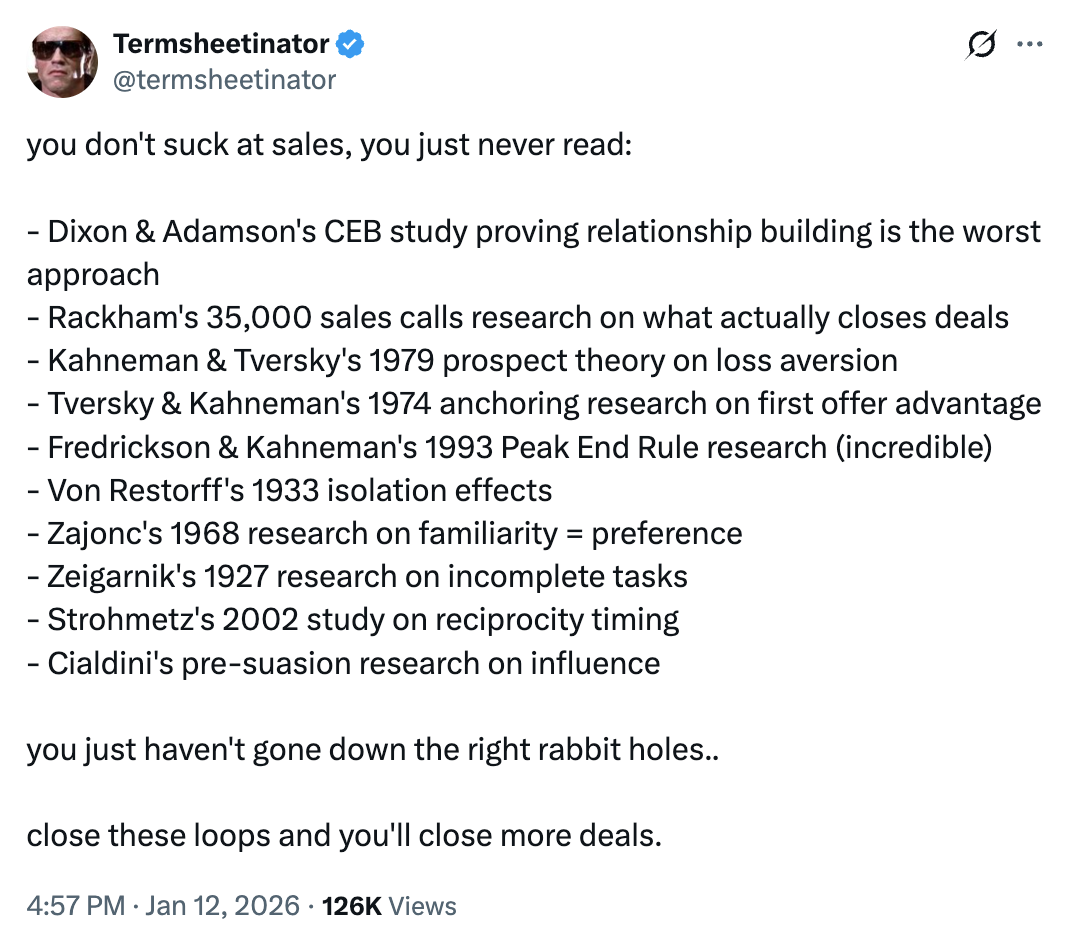
If you’re like me, and you haven’t heard of many of these, I’ll share a brief overview of these. I think they can be very helpful if you’re doing b2b sales.
1) Dixon & Adamson, CEB study
Core finding: Relationship building is negatively correlated with winning complex deals.
What to understand:
The CEB research behind The Challenger Sale showed that buyers do not reward friendliness, responsiveness, or long relationships in complex B2B sales. They reward sellers who change how they think.Top performers did three things:
Taught the customer something non-obvious about their business
Reframed the problem before proposing a solution
Took control of the buying process
Sales implication:
If your pitch sounds like “Tell me about your challenges” you are already losing.
You win by saying “Here is the problem you are underestimating, and here is why it is costing you more than you think.”Relationship follows insight, not the other way around.
2) Neil Rackham, 35,000 sales calls
Core finding: Features do not close deals. Implications do.
What to understand:
Rackham found that top performers almost never push product features. Instead, they:
Ask implication questions that expand the cost of the problem
Delay solution talk until the pain is fully quantified
Example:
Bad: “Our AI automates document processing”
Good: “What happens when one missing document delays a shipment by 48 hours?”
Sales implication:
If the buyer does not verbalize the consequences themselves, they will not act.
Your job is to make the cost of inaction feel operationally dangerous.3) Kahneman & Tversky, 1979 Prospect Theory
Core finding: Losses are felt about twice as strongly as gains.
What to understand:
People do not buy to win. They buy to avoid loss.
A guaranteed small loss feels worse than a probabilistic larger gain feels good.Sales implication:
Do not sell upside first. Sell downside.
Not: “This will increase efficiency by 20%”
But: “Every month this stays manual, you are leaking X in delays, errors, and rework”
The deal closes when doing nothing feels irresponsible.
4) Tversky & Kahneman, 1974 Anchoring
Core finding: The first number or frame anchors all future judgment.
What to understand:
Even arbitrary anchors distort perception. Once an anchor is set, all negotiation happens around it.Sales implication:
Whoever frames the problem first controls the deal.
If procurement anchors on price before you anchor on cost, you lose.Always anchor on:
Total cost of the problem
Scale of operational risk
Strategic downside of delay
Only then discuss pricing.
5) Fredrickson & Kahneman, 1993 Peak-End Rule
Core finding: People remember peaks and endings, not averages.
What to understand:
The buyer will not remember most meetings. They will remember:
The most emotionally salient moment
The final interaction before the decision
Sales implication:
Design the process.
Create a sharp insight moment where the buyer says “I hadn’t thought of it that way”
End with clarity, not discussion. Clear next step, clear framing, no ambiguity
A messy ending kills deals even if everything before was good.
6) Von Restorff, 1933 Isolation Effect
Core finding: The thing that is different is remembered.
What to understand:
When everything looks the same, nothing stands out. Novelty creates memory.Sales implication:
If your pitch sounds like every vendor, you are invisible.
You must isolate one distinctive idea:
A nonstandard metric
A contrarian insight
A unique deployment model
One sharp difference beats ten generic benefits.
7) Zajonc, 1968 Mere Exposure Effect
Core finding: Familiarity increases preference.
What to understand:
Repeated exposure creates comfort, even without persuasion.Sales implication:
Deals die when you disappear.
Short, lightweight touchpoints matter more than long, heavy ones.
Slides, short notes, one-page memos, quick Looms. These build cognitive ease.By the time they decide, you should feel familiar, not risky.
Pair with: How to Sell
6) Follow-up
Always follow up same-day. No excuses. Do not leave your follow-ups till tomorrow. Just get it done then and there, it shows you’re on top of things and the signalling value is super important, plus lags are the death of sales so you always want to take care of your end of things as quickly as is humanly possible.
Your follow-up should be short, gracious, and include a clear call to action for the agreed next step. For example, if you decided a follow-up call made sense, you want something along the lines of “You mentioned a call next Monday afternoon would be good; I’ll send an invite for 3.30 and just let me know if you’d prefer a different time.” etc.
Finally —follow up relentlessly. People drop off the radar even when the sales call went incredibly well, and it’s usually just because they’re busy, not because they hate you. I can’t tell you how many big deals I closed where I had to follow up >15 times to get the deal done. Be shameless here — you want to get a clear “no” or a clear “yes” or a clear “I’m doing XYZ and it will take me 5 days, follow up next week”. I usually followed up every 3 days or so, but people differ and the specifics matter here.
What I Read
Capital in the 22nd Century
A thought-provoking piece:
If AI is used to lock in a more stable world, or at least one in which ancestors can more fully control the wealth they leave to their descendants (let alone one in which they never die), the clock-resetting shocks could disappear. Assuming the rich do not become unprecedentedly philanthropic, a global and highly progressive tax on capital (or at least capital income) will then indeed be essentially the only way to prevent inequality from growing extreme. Without one, once AI renders capital a true substitute for labor, approximately everything will eventually belong to those who are wealthiest when the transition occurs, or their heirs. Or more precisely, it will belong to the subset of this group who save most and most invest with a view to maximizing long-run returns.
Pair with: This response
I’ve seen a lot of people misunderstand what we’re saying. Our claim is that in a world of full automation, inequality will skyrocket (in favor of capital holders).
People aren't thinking about the galaxies. The relative wealth differences in a thousand years—or a million—will be downstream of who owns the first dyson swarms and space ships. And space colonization isn't bottlenecked by people’s preference for human nannies and waiters.
So even if you can make 10 million dollars a year as a nanny in the post-abundance future, or get a 10 million dollar charity handout, Larry Page’s million cyborg heirs can own a galaxy each.
You might think this is fine! Why is inequality intrinsically bad, especially if absolute prosperity for everyone goes up? Fair enough, but to me quadrillion fold differences in wealth between humans seem hard to justify in a world where AIs are doing all the work anyways - these disparities in wealth are not incentivizing hard work or entrepreneurship or creativity, which is what we use to justify inequality today.
What I’ve Learned from Watching People Wait to Have Children
Sad but important topic:
Despite amazing innovations in fertility medicine, women who reach a certain age are forced to face an inconvenient truth: There is a biological window of fertility, and for safely bearing healthy children. (And men have one, too.)
But saying this out loud has somehow become taboo. Instead, young women and men are being comforted by the false premise that childbearing may be delayed without consequences. The science says differently. And while developments like egg-freezing and IVF have contributed mightily to extending fertility, they are also not the guarantees the public perceives them to be.
Pair with: How Did Having Babies Become Right-Wing?
You Cannot Destroy the Elite
Interesting take:
What do Madeleine Albright, the controversial US Secretary of State, and Václav Havel, the playwright and first president of the Czech Republic, have in common?
Both were born into elite Czech families in the 1930s. Albright, born Marie Jana Körbelová, was the daughter of a prominent diplomat who served as the Czech ambassador to Yugoslavia. Havel was the son of a wealthy real estate developer who owned the Lucerna Palace shopping complex. Following the communist coup in 1948, both families had their property confiscated by the state. Owing to his bourgeois background, Havel was branded a “class enemy” and could not pursue the education he wanted. He later spent time in prison as a political dissident. Albright would have likely faced the same fate had her family not fled to the US when the communists took over. (They had already fled the country once in 1939, before returning at the war’s end.)
Despite all this, Albright and Havel went on to achieve great success in their respective fields. Which illustrates an important point: you cannot destroy the elite. You can seize people’s property. You can round them up and put them in camps. You can even kill their family members. But sooner or later, they will regain their former status.
Pair with: The Disadvantage of an Elite Education
I’m not talking about curricula or the culture wars, the closing or opening of the American mind, political correctness, canon formation, or what have you. I’m talking about the whole system in which these skirmishes play out. Not just the Ivy League and its peer institutions, but also the mechanisms that get you there in the first place: the private and affluent public “feeder” schools, the ever-growing parastructure of tutors and test-prep courses and enrichment programs, the whole admissions frenzy and everything that leads up to and away from it. The message, as always, is the medium. Before, after, and around the elite college classroom, a constellation of values is ceaselessly inculcated.
My productivity app is a never-ending .txt file
I’m more and more attracted by simplicity in work and life setups. Maybe it’s the side effect of entering in my 30s.
The biggest transition for me when I started college was learning to get organized. There was a point when I couldn’t just remember everything in my head. And having to constantly keep track of things was distracting me from whatever task I was doing at the moment.
So I tried various forms of todo lists, task trackers, and productivity apps. They were all discouraging because the things to do kept getting longer, and there were too many interrelated things like past meeting notes, calendar appointments, idea lists, and lab notebooks, which were all on different systems.
I gave up and started just tracking in a single text file and have been using it as my main productivity system for 14 years now. It is so essential to my work now, and has surprisingly scaled with a growing set of responsibilities, that I wanted to share this system. It’s been my secret weapon.
The IQ bell curve meme all over again!
Seed to Nowhere: Inside Morocco’s Scale-Up Trap
Great read for my Moroccan friends, or if you’re interested in the startup landscape in Morocco.
TL;DR
Morocco’s funding “boom” is misleading. A record year on paper, but most of the capital went to three startups. Everyone else is still stuck at seed, and the capital ladder snaps the moment founders need a real Series A.
Morocco can start startups, but it still can’t scale them. Growth money dries up fast, top teams leave to raise abroad, and the exit market is basically nonexistent. No exits → no liquidity → no recycled capital → no ecosystem.
The talent base is thin where it matters. Too few builders, too many talkers, and an education pipeline that produces degrees, not product execution.
High-friction operations, slow regulation, and a dormant diaspora drain momentum. Until Morocco fixes these fundamentals, it will remain “promising but not delivering.”
Pair with: Totally unrelated, but as Morocco becomes a touristic powerhouse, I find it useful to study the case of Vietnam and to understand that tourism will not lead to the GDP growth that we’re looking for. Vietnam’s GDP could top Thailand’s this year as growth accelerates
Vietnam is on course to surpass Thailand in nominal GDP as early as this year, with large-scale public works projects propelling rapid economic growth.
Vietnam’s real gross domestic product grew an estimated 8% or so in 2025, and Hanoi targets growth of over 10% in 2026 and beyond. Though some see this goal as overly ambitious, Prime Minister Pham Minh Chinh stressed that “double-digit growth is achievable” at an economic event in December.
If growth accelerates as planned, nominal GDP for Vietnam could reach the mid-$500 billion level in 2026 or 2027, surpassing Thailand and potentially becoming the third-largest economy in Southeast Asia after Indonesia and Singapore. Per capita GDP would exceed $5,000, approaching that of Indonesia.
Brain Food
Screentime for kids
When toddlers get iPads, does it change brain development?
A longitudinal study from Singapore says yes and shows links: accelerating visual and cognitive control networks early predicts later effects on decision making, and later increases in anxiety:
Background
Infant screen time is linked to many negative outcomes, including anxiety, but the underlying neural correlates and pathways remains understudied. We aimed to assess the directional association between infant screen time, development of brain network topology, decision-making behaviour and anxiety symptoms in adolescence.
Findings
Higher infant screen time was associated with a steeper decline in visual-cognitive control network integration from ages 4.5–7.5 years (β = −1.03 (−1.61, −0.46)), which mediated increased CGT deliberation time at age 8.5. Deliberation time, in turn, was associated with greater anxiety symptoms at age 13. A full serial mediation pathway was significant, linking infant screen time to later anxiety via accelerated brain network maturation and decision-making behaviour (β = 0.033 (0.002, 0.160)).
Interpretation
Higher infant screen time is linked to accelerated topological maturation of the visual and cognitive control networks, leading to prolonged decision latency and increased adolescent anxiety. Sensory processing impairment may underlie this novel neurodevelopmental pathway, highlighting a potential target for early intervention.
What I’m Watching
Break Into Frontier AI Research
Very interesting video for those looking to get into frontier AI research.
Start with ML and deep learning courses. University or online both work. Learn undergrad-level math and revisit it as needed.
Move quickly to reading papers. This builds a mental map of the field.
Read papers efficiently. Abstract first, then jump to the core sections.
To find related work, use citations. Go backwards via references and forward via papers that cite it.
To start doing research, pick a paper with public code. Run it, tweak parameters, test new ideas.
Research is about building on existing work, not reimplementing everything from scratch.
Math matters, but scope depends on your role. Theoretical work needs deep math. Empirical work needs enough to understand what’s going on.
Reach out to PhD students, professors, or paper authors for guidance or collaboration.
Terry Tao: “LLMs Are Simpler Than You Think – The Real Mystery Is Why They Work!”
Terence Tao says the math behind today’s LLMs is actually simple. Training and running them mostly uses linear algebra, matrix multiplication, and a bit of calculus, material an undergraduate can handle. We understand how to build and operate these models.
The real mystery is why they work so well on some tasks and fail on others, and why we cannot predict that in advance. We lack good rules for forecasting performance across tasks, so progress is largely empirical.
A key reason is the nature of real-world data. Pure noise is well understood, perfectly structured data is well understood, but natural text sits in between, partly structured and partly random. Mathematics for that middle regime is thin, similar to how physics struggles at meso-scales between atoms and continua.
The Tool of the Week
Creatine
Back full circle here. I’ve had a few weeks without training due to travelling and work. Completely lost the momentum and confirmed that the less you do, the more tired you are.
Retrying a few months of 10g of creatine monohydrate per day to see if I can witness any material impact on performance.
Additionally, the only supplements I can’t live without are electrolytes before training and magnesium before sleep.
Quote I’m Pondering
If we’re aiming to create works that are exceptional, most rules don’t apply. Average is nothing to aspire to.
The goal is not to fit in.
If anything, it’s to amplify the differences, the special characteristics unique to how you see the world.
Instead of sounding like others, value your own voice.
Develop it.
Cherish it.
As soon as a convention is established, the most interesting work would likely be the one that doesn’t follow it."
— Rick Rubin

Barcelona 🫶 - hit me up for a coffee if you’re in Barcelona ☕EndNote
Thanks for reading,
If you like The Long Game, please share it or forward this email to someone who might enjoy it!
You can also “like” this newsletter by clicking the ❤️ just below, which helps me get visibility on Substack.
Also, let me know what you think by leaving a comment!
Until next time,
Mehdi Yacoubi
Hadn't seen post about unfair advantage but absolutely love it. I've been attempting to communicate that to my teenage grandkids and this gives me even greater reason to continue doing it. Thanks
Ah- that's a better point. Effectively, as I am painfully aware, for the AI to take over today it needs you to tell it quite precisely (not nearly as exactly as RPA happily) what you are asking it to take over. And everything you say about that is correct.
Where I agree with you is on older and "artisanal" systems. Step 1 of one of my current project is, I kid you not, "migrate HCL Notes workflow to SharePoint" (I last used what was then IBM Notes more than 15 years ago!).
Where we differ is that I fully expect Claude 6 with system access to be able to observe any given user's behaviour over the course of say 3 months, and then to completely take it over, and in 90% of cases, improve it.
Many ERPs take more than that timeframe now (I mainly work with much bigger companies), but I am happy to take a bet (or to create a manifold/metaculus market and both bet, but let others enjoy the fun) on that specific point or some broader or narrower relation of it, if we can define terms sufficiently clearly.